A warm, practical guide for exhausted caregivers navigating illness at home
There's a particular kind of quiet that settles over a house in the middle of the night when your child is sick. The thermometer has been out since dinner. You've checked on them three times in the last hour. You're running on adrenaline and cold coffee, toggling between Google searches you probably shouldn't be reading and the soft glow of your child's nightlight.
First, take a breath.
You are not alone in this. Every parent has had a night — or several — exactly like this one. And while no blog post can replace the guidance of your child's pediatrician (more on that throughout), what can help is feeling a little more prepared, a little more organized, and a whole lot less like you're navigating this in the dark.
That's what this guide is for.
🌙 You're Already Doing the Most Important Thing
Showing up. Staying close. Paying attention.
When a child is sick, the most powerful thing a caregiver can do isn't always doing something — it's being present, calm, and observant. Children are remarkably perceptive. When they sense that the grown-up in the room is steady and reassuring, it genuinely helps them feel safer, even when they feel terrible.
So before we dive into the practical stuff, let's just acknowledge: you're already a good parent because you're here, paying attention, and trying to do right by your kid. That matters more than you know.
📋 Step One: Observe and Write Everything Down
One of the most useful things you can do during a sick night — and one that will make your pediatrician's job significantly easier — is to become a careful observer and note-taker.
You don't need a medical degree to do this. You just need a notepad, your phone, or a tracking app. Here's what's worth paying attention to and recording:
What to Note
- Temperature readings — Write down the time of each reading and the method used (ear, forehead, underarm, oral, rectal). Consistency in method helps paint a clearer picture over time.
- Symptoms you're observing — Is there a cough? Is it dry or wet-sounding? Any rash? Vomiting? Diarrhea? Complaints of ear pain, sore throat, or tummy ache?
- Behavior and energy levels — Is your child lethargic and hard to rouse, or cranky but alert? Are they drinking fluids? Are they able to be comforted?
- Sleep patterns — How long are they sleeping? Are they restless? Waking frequently?
- Appetite — Are they refusing all food and drink, or just not very hungry?
- Any medications given — The name of the medication, the time it was given, and the dose as directed by your healthcare provider. (More on this below.)
- When symptoms started — As specifically as you can remember.
Why This Matters
When you walk into the pediatrician's office the next morning — bleary-eyed and worried — and the doctor asks, "When did the fever start? Has it been consistent? What have you given them and when?" — you will be so glad you wrote it down.
Memory under stress and sleep deprivation is notoriously unreliable. A written log transforms a fuzzy, anxious recollection into a clear, useful timeline that helps your child's care team make better-informed decisions.
Always consult your pediatrician or a qualified healthcare professional with any questions about your child's symptoms, health, or care.
💊 A Note on Medications: Please Ask Your Doctor
This is important, so we're going to say it clearly and kindly:
This blog post will not tell you which medications to give your child, what doses are appropriate, or how to treat any symptom or condition.
That's not us being unhelpful — that's us being responsible. Medication decisions for children depend on a child's age, weight, specific symptoms, medical history, and other factors that only a qualified healthcare professional can properly assess.
If you have questions about whether to give your child any medication, what to give, or how much, please call your pediatrician's office. Many practices have after-hours nurse lines specifically for situations like this. That phone call is exactly what those services exist for — use them without hesitation.
What you can do is keep an accurate record of anything that has been given, including the time and the dose as instructed by your provider. That record is invaluable for your care team.
🚨 Know When to Seek Urgent or Emergency Care
While this guide focuses on general support and organization, it's essential to say this clearly:
Some symptoms require immediate medical attention. Do not wait for a scheduled appointment if your child shows any signs that concern you.
Trust your instincts. You know your child. If something feels wrong — if they seem unusually difficult to wake, are having trouble breathing, have a rash that's spreading rapidly, are inconsolably crying, or if you are simply scared — seek emergency care or call emergency services immediately.
When in doubt, call your pediatrician's after-hours line, an urgent care clinic, or go to the emergency room. No blog post, app, or well-meaning friend is a substitute for a real medical professional when you're worried about your child's safety.
🏥 Preparing for the Pediatrician Visit
One of the best things you can do during a long sick night is prepare for the morning appointment — even before you've made it.
Here's how to set yourself up for a productive visit:
Before You Call or Go In
- Gather your notes. All those observations you've been writing down? Organize them into a simple timeline. When did symptoms start? What have you noticed? What's changed?
- Write down your questions. In the moment, it's easy to forget what you wanted to ask. Jot down every question as it occurs to you, no matter how small it seems.
- Know your child's basics. Have their date of birth, current weight (if you know it), any known allergies, and any current medications or supplements on hand.
- Bring your medication log. If anything has been given, bring a clear record of what, when, and how much — as directed by a healthcare provider.
- Note any recent exposures. Has your child been around anyone who was sick recently? Any new foods, environments, or activities? This context can be helpful.
During the Visit
- Lead with your biggest concern. Don't save the most worrying thing for the end. Start with what's scaring you most.
- Ask for clarification. If the doctor uses terms you don't understand, ask them to explain. There are no silly questions when it comes to your child's health.
- Ask what to watch for. Before you leave, ask your provider what signs or changes should prompt you to call back or return sooner.
🛋️ Comforting a Sick Child at Home
While you're waiting for morning, or recovering from the visit, your child still needs you — and comfort is something you can absolutely provide.
The Power of Presence
Sometimes the most therapeutic thing in the world is a parent sitting close by. You don't have to fix everything. You just have to be there. Hold their hand. Stroke their hair. Speak softly. Let them know they're safe and loved.
Creating a Cozy Sick-Day Space
- Set up a comfortable spot — their bed, the couch, or a nest of blankets on the floor — wherever they feel most at ease.
- Have their favorite stuffed animal, blanket, or comfort object close by.
- Keep the environment calm: dim lights, quiet sounds, gentle voices.
- Have a small basin or bag nearby if nausea is a concern — being prepared reduces everyone's stress.
- Keep water or fluids within easy reach. (Your pediatrician can advise on what's appropriate for your child's situation.)
Distraction and Gentle Entertainment
When your child is feeling well enough to be bored but not well enough to be active, gentle distractions can be a gift:
- A favorite movie or show they've seen a hundred times (familiar is comforting when you feel awful)
- Audiobooks or gentle music
- Simple, low-energy activities like coloring or looking through a picture book together
- Just talking — asking them to tell you about their favorite things, their dreams, their imaginary worlds
Listening to What They Tell You
Children, even very young ones, often communicate a lot about how they're feeling — sometimes in words, sometimes in behavior. Take their complaints seriously. If they say something hurts, believe them. If they seem more distressed than usual, pay attention. Your observations matter, and so do theirs.
👨👩👧 Coordinating Care Among Multiple Caregivers
If you're co-parenting, have a partner, share care with grandparents, or have a nanny or daycare involved, a sick child can quickly create communication chaos.
"Did she already have her medicine?" "What time did you take his temperature?" "Did anyone call the doctor yet?"
Sound familiar? Here's how to keep everyone on the same page:
Designate a Point Person
For each sick episode, it helps to have one person who is the primary keeper of the log and the main communicator with the healthcare provider. This doesn't mean others can't help — it just means there's one source of truth.
Share Information in Real Time
Whether it's a shared note in your phone, a group text thread, or a dedicated app, make sure everyone caring for your child has access to the same up-to-date information:
- Current symptoms and when they started
- Temperature readings and times
- Any medications given (name, time, dose as directed by your provider)
- What the doctor has said
- What to watch for
Reduce Duplication and Gaps
The two biggest risks when multiple caregivers are involved are giving something twice by accident and assuming someone else already handled something. A shared, real-time log eliminates both of those risks.
Be Kind to Each Other
Caring for a sick child is stressful, and stress can make people snappy. Give each other grace. You're on the same team. The goal is a healthy, comfortable child — and that's something you're working toward together.
🌿 Taking Care of Yourself, Too
We can't talk about surviving a long sick night without talking about you.
Caregiver burnout is real. Sleep deprivation is real. The anxiety of watching your child suffer — even from something relatively minor — is genuinely hard. And you cannot pour from an empty cup.
Rest When You Can
If your child is sleeping, try to sleep too — even briefly. The dishes can wait. The laundry can wait. Your body needs rest to function, and a rested caregiver is a better caregiver.
Tag In When Possible
If there's another adult who can take a shift, let them. Accepting help is not weakness — it's wisdom. Even a two-hour break can restore your ability to be calm and present.
Eat Something
It sounds almost laughably simple, but caregivers often forget to eat when they're focused on a sick child. Have something nourishing, even if it's small. Your brain and body need fuel.
Manage Your Own Anxiety
It is completely normal to feel anxious when your child is sick. Here are a few things that can help:
- Focus on what you can observe and control — your notes, your presence, your next step.
- Limit late-night Googling — search results at 2 a.m. tend to lead to worst-case scenarios that increase anxiety without providing useful guidance. If you have concerns, write them down and ask your pediatrician.
- Talk to someone — a partner, a friend, a family member. Sometimes just saying "I'm worried and I'm tired" out loud helps.
- Remind yourself of your competence — you have gotten through hard nights before. You know your child. You are paying attention. That is enough.
Give Yourself Credit
Parenting a sick child through a long night is genuinely hard work. It's physically and emotionally demanding. When morning comes and your child is on the mend, take a moment to acknowledge what you did. You showed up. You stayed calm (mostly). You kept watch. That's love in action.
📝 A Quick Checklist for the Long Night
Here's a simple at-a-glance summary to keep handy:
- [ ] Start a written log — symptoms, temperatures, times, observations
- [ ] Record any medications given (name, time, dose as directed by your provider)
- [ ] Write down your questions for the pediatrician
- [ ] Create a comfortable, calm space for your child
- [ ] Share your log with all caregivers in real time
- [ ] Know your pediatrician's after-hours number
- [ ] Know when to seek urgent or emergency care — and don't hesitate
- [ ] Drink some water. Eat something. Rest when you can.
⚠️ Disclaimer
This blog post is intended for general educational and informational purposes only. It is not medical advice, and it is not a substitute for professional medical guidance, diagnosis, or treatment. The information shared here does not cover all possible situations and should not be used to make medical decisions for your child.
Always consult your child's pediatrician or a qualified healthcare professional with any questions or concerns about your child's health, symptoms, medications, dosing, or care. If you believe your child is experiencing a medical emergency, call emergency services or go to the nearest emergency room immediately.
Every child is different, and only a qualified healthcare professional who knows your child can provide appropriate medical advice.
📱 One More Tool for Your Toolkit: Fever Whiz
All of that note-taking and care coordination we talked about? There's a free app designed to make it easier.
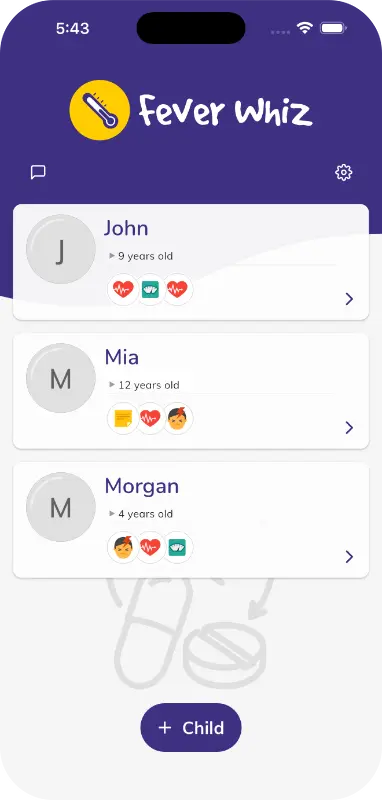
Fever Whiz is a free child medication, fever, and symptom tracker built for exactly the kind of night we've been describing. With Fever Whiz, you can:
- Log temperatures, symptoms, and medications with timestamps, so nothing gets forgotten or duplicated
- Set custom and smart reminders so you don't have to keep track of timing in your head
- Visualize trends with charts to see how your child's symptoms are changing over time
- Store important medical documents — vaccination records, insurance cards, provider notes — all in one place
- Keep care notes and manage your care team so everyone involved knows what's happening
- Sync in real time across everyone caring for your child, so grandma, your partner, and the babysitter are all looking at the same up-to-date information
Fever Whiz is a private record-keeping and organization tool — not a medical device — and it does not provide medical advice or diagnosis. Think of it as a calm, organized co-pilot for the long night: keeping your information straight so you can stay focused on what matters most — your child.
You've got this. One hour at a time. Morning always comes.
Have questions about your child's health? Always reach out to your pediatrician or a qualified healthcare professional. They're there to help — and so are you.