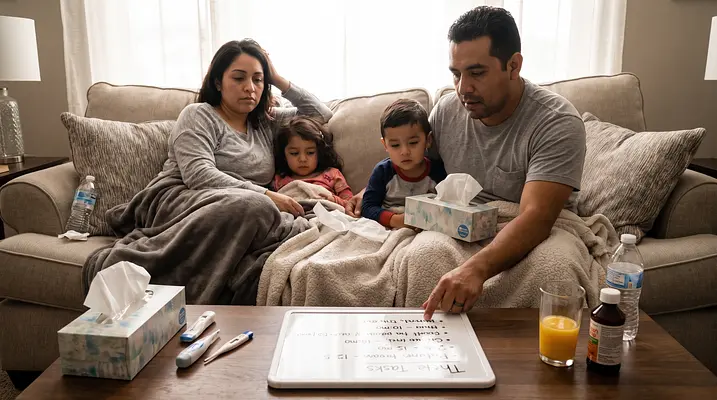
There is a special kind of hard that arrives when the bug that flattened your child comes for you next. Suddenly the person running the sick ward is also a patient, and everything that felt manageable on ordinary sick days feels like wading through wet sand. If your whole household is down at once, the goal is not to parent at your usual standard - it is to keep everyone safe, rested, and cared for until the fog lifts.
Families get through these stretches the same way ships get through storms: by simplifying. Meals get simpler, screens get more generous, and the to-do list shrinks to essentials. Just as importantly, the household stops relying on anyone's memory. When every adult in the house is foggy, tired, and running on interrupted sleep, writing things down and taking turns become survival skills, not nice-to-haves.
This post is a field guide for those weeks. It will not make anyone feel better faster - that is a conversation for your doctor and your child's pediatrician - but it can make the week more organized, more restful, and a lot less lonely.
🛋️ Lower the Bar to Essentials
The first move when everyone is sick is deliberate: decide, out loud, that this is a bare-minimum week. Fed, hydrated, rested, and comforted is the whole job. Everything else can wait, and giving yourself permission early beats feeling guilty all week.
- Name the essentials for your household - food, fluids, rest, comfort, and any care your doctors have advised - and let everything else slide.
- Cancel or postpone every non-essential commitment now, in one batch of messages, instead of agonizing one by one.
- Serve easy food without apology, whether that is toast, delivery, or cereal for dinner.
- Relax screen-time rules on purpose and without guilt, because a resting child watching a movie is a child who is resting.
- Set up a comfortable base camp - couch, blankets, water bottles, tissues - so kids and adults can rest in the same room with minimal running around.
📝 Write Everything Down So Nobody Has to Remember
A foggy brain is a forgetful brain, and when two exhausted adults are trading off care, details fall through the cracks: who was given what and when, whose temperature was taken, which kid slept and which did not. A simple shared log removes memory from the equation entirely.
- Keep one shared log for the whole household - a notebook on the counter or a shared app - rather than separate notes in separate places.
- Record each temperature, medication given, and notable symptom at the moment it happens, not later from memory.
- Note timing details for each entry, because "when did this start" and "when was the last dose" are exactly what doctors ask and exactly what tired brains lose.
- Log the adults' information too, since sick parents forget their own details just as easily as their kids'.
- Check the log at every handoff instead of quizzing each other, so the tired parent coming off shift can just go to sleep.
😴 Tag-Team Rest in Real Shifts
Two half-functional parents both hovering all day produces two fully broken parents by Wednesday. Shifts feel overly formal for family life, but they are the single best tool for making sure each adult gets real, horizontal, uninterrupted rest.
- Split the day into explicit on-duty and off-duty blocks, and treat off-duty as sacred rest time, not chore time.
- Send the off-duty parent to an actual bed, ideally behind a closed door, rather than dozing upright in the middle of the action.
- Cover the nights too, by alternating who answers wake-ups or splitting the night into halves.
- Adjust shifts honestly based on who is sickest, and say plainly when you are too unwell to safely take a turn.
- Hand off with a 60-second update plus the log, then let go - the on-duty parent has it from here.
🆘 Ask for Outside Help Sooner Than Feels Natural
Most people wait until they are desperate to ask for help, and most friends and family genuinely wish they had been asked sooner. When every adult in the house is sick, outside help is not a luxury - it is the missing healthy adult your household temporarily needs.
- Make the specific ask, because "could you drop groceries on the porch" gets a yes far more easily than "let us know if you need anything."
- Use no-contact help freely: porch drop-offs, meal deliveries, pharmacy pickups, and dog walks all happen without spreading germs.
- Keep a pre-arranged backup caregiver list - the two or three people you have already asked, in advance, to be your emergency bench - and activate it without shame.
- Let a healthy relative or friend take a video-call shift, reading stories to a bored sick kid while you lie flat for twenty minutes.
- Accept imperfect help graciously, because the casserole you would not have cooked and the folded laundry in the wrong drawers are still wins.
🩺 Keep Notes Ready for Everyone's Doctor Visits
When a whole household is sick, there may be multiple appointments in the same week - the pediatrician for the kids, your own doctor for the adults. Walking in with clear notes makes every one of those visits faster and more useful, especially when your memory is mush.
- Bring the shared log, or a photo of it, to every appointment instead of reconstructing the week from memory.
- Prepare a one-line timeline per person - when it started, how it has changed - before each visit.
- Write your questions down beforehand, because foggy brains forget them the moment the doctor walks in.
- Contact your pediatrician or doctor promptly with any concern, question about symptoms, or medication question, rather than waiting until you feel more organized.
- Record what each clinician said right after the visit, in the same shared log, so both parents hear the same instructions.
✅ Quick Action Plan
- Declare a bare-minimum week and batch-cancel everything non-essential.
- Start one shared household log for temperatures, medications, symptoms, and times - adults included.
- Set up on-duty and off-duty shifts so each parent gets real rest.
- Send two specific help requests to friends or family today.
- Line up your backup caregiver bench before you are desperate.
- Bring the log and a written question list to every doctor visit this week.
This article is for educational purposes only and is not medical advice. Always consult your pediatrician, your own doctor, or another qualified healthcare professional for any medical questions, symptoms, medications, or treatment decisions, and seek urgent care immediately for any emergency or warning signs in a child or an adult.
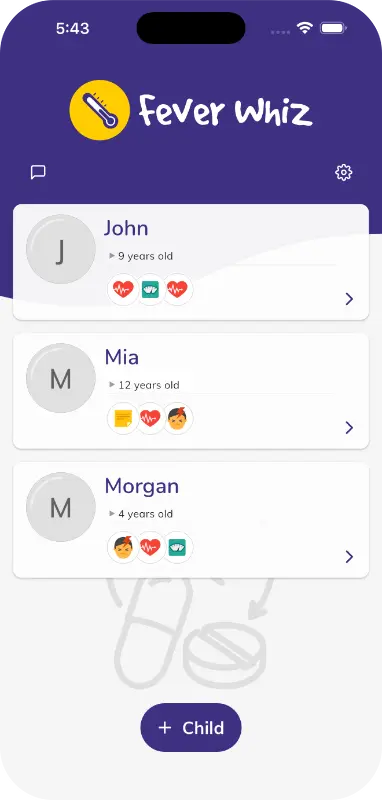
When the whole house is down and nobody's brain is at full power, the Fever Whiz app can be the shared memory your family needs. Log every temperature, dose, and symptom in one place, set reminders so nothing slips, and sync in real time so whichever parent is on shift sees exactly what happened on the last one. It is a free, simple way to stay organized until everyone is back on their feet.